|
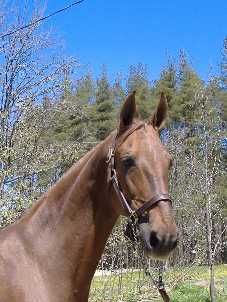
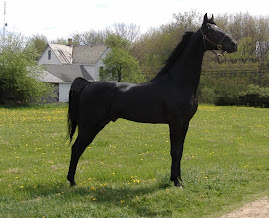
| Enjoying the first sprigs of Spring grass |
Monday, April 20, 2015

Wednesday, January 16, 2013
The First Day of the Rest of Her Life
Today Miss Poppy Black calmly boarded a horse trailer for the first time ever and left for her new home.
Naturally, only the best home would do. Her new owner lives in our area and has been a horse friend of ours for decades. She owned a full sister to Poppy's dam Copy, and currently owns two other youngsters by Poppy's sire Clint. Besides being a good friend, wonderful amateur rider, and competent trainer, she is also a trained farrier. She used to shoe one of my Saddlebred show horses many years ago.
We believe she and Poppy will be a great team and we look forward to cheering them on in their successes in the future.
Naturally, only the best home would do. Her new owner lives in our area and has been a horse friend of ours for decades. She owned a full sister to Poppy's dam Copy, and currently owns two other youngsters by Poppy's sire Clint. Besides being a good friend, wonderful amateur rider, and competent trainer, she is also a trained farrier. She used to shoe one of my Saddlebred show horses many years ago.
We believe she and Poppy will be a great team and we look forward to cheering them on in their successes in the future.
Tuesday, July 3, 2012

Tuesday, May 29, 2012
Greener Pastures
 |
| "Walker" and Copy |
A couple of months ago, some friends called and asked if my mother knew of any old horses that needed a home. Their herd dynamic was "off" with three horses, and someone was in need of a friend.
Mom had sold these folks a walking horse and a pony and knew it was an excellent home, so she almost immediately volunteered Copy. Our "herd dynamic" was a bit off too, since the filly has a pony friend, and the geldings are on individual turnout. Copy was being "neglected" if that's possible at Mom's house.
They said they would come and meet her and decide if they liked her. Mom got on the phone with Saddlebred Rescue about the potential re-adoption, and we waited.

Not long after, they came to visit and decided that Copy was beautiful and elegant. Since she loves men, and the "interested person" in this couple was the husband, I'm sure she turned on her charm. The adoption was approved, and a date set.
 |
| Macaroni (the pony), Walker, Copy and the Percheron |
Soon after the couple returned from a spring vacation, Copy headed out to her new digs with a care package full of peppermints, peanuts and her favorite pink grooming tools. She is now Queen of a small herd in a beautiful 40 acre pasture. She immediately established herself in charge and with a firm double barrel kick in the chest, relegated the ancient Percheron (former herd Boss) to third in command behind her new beau "Walker".

All is now peaceful and Copy is very happy. Mom went to visit her last week and was shocked that Copy let her pet her head. Copy is normally disdainful and aloof. I told Mom this means Copy is "grateful" for her new retirement home.
 |
| What? |
Monday, January 9, 2012
Update: Poppy Black

By request, here is an update on the filly. Her papers are being processed, and her name is Poppy Black. Mom actually got that idea from a reader of my side saddle blog who left a comment. Our first Choice was "Filigree" but that was taken. So Poppy Black it is, which is sort of a combo of Sensational Copy and First Black Out.
Not much news, nor many pictures. She's weaned. She lives a very mundane life doing nothing all day with her School Marm pony "Bubbles".

Mom brought Bubbles home with no real plan. I encouraged her to use her as a weaning companion since that was her previous job. She was already doing that job for our friend Catherine. I think Mom just wanted her so she could look out the window at her.

She is just about as cute as any pony can be and she sort of reminds me of something... what is it? Oh I know. One of Mom's favorite childhood books.

 Childhood dream come true!
Sunday, October 2, 2011
I know I said it was over

But I thought you would enjoy these photos of Ace's little sister. She recently had her first farrier visit and behaved like a lady. She stood stock still while the loud, strange man picked up her legs and rasped away while telling a story. Mom said she asked him if "we could please finish the last foot before we finish the story?" After all, she had never actually had her front feet picked up. The back ones yes, but Mom never bothered with the front ones.
No matter. One day months ago, while I was "baby-wrangling" for Mom I accidentally knocked her down and fell on top of her and it made a permanent impression as to the superior strength of humans. Well, depending on who's telling the story, maybe the baby threw a fit and knocked me down. But the landing was the same and she has been very respectful of humans since then.


Tuesday, June 14, 2011
The End
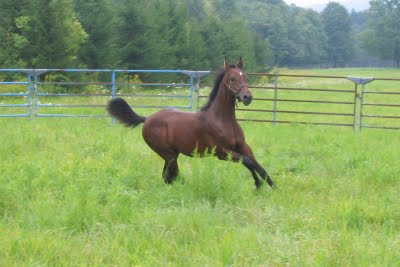
I am sad to report that this is the end of Ace's blog. We received word this week that he was humanely euthanised over the weekend. For the past few weeks he had not been acting right. That morning he did not come up to be fed with the other horses, and his owner's husband found him down in the pasture and unable to get to his feet. The decision was made to have him destroyed there.
In my opinion this is for the best. A buyer had been found who was looking for a young horse as a project, but I am happy he did not have to go to yet another new place with his issues. Now I won't have to track him and worry about him for the next 20 some years.
The new filly "Sonia" is doing very well. Perhaps she will make an appearance now and then on The Grey Horse blog.
In my opinion this is for the best. A buyer had been found who was looking for a young horse as a project, but I am happy he did not have to go to yet another new place with his issues. Now I won't have to track him and worry about him for the next 20 some years.
The new filly "Sonia" is doing very well. Perhaps she will make an appearance now and then on The Grey Horse blog.
Tuesday, May 31, 2011


Monday, May 30, 2011
It's a Girl

A week early, but four and a half hours late to be on Mom's Birthday.
Bay with a star and one front pastern white. Copy delivered her quickly and easily when my Stepdad went to the house for some coffee in between checking the mare and his cows that are due. She was on her feet in half an hour, and nursing not too long after. She is smaller than Ace was which made the deliver that much easier. Both Mama and baby are doing fine. She is very vocal just like Ace was. Copy nickers and she whinnys back loudly.
Thursday, May 19, 2011
18 days and counting
Copy has reached the "OMG I am so fat" stage.

Today she spent her nap time nickering to herself and groaning exhaustedly.

Then she turned her nose up at some grass that was picked from the wrong part of the lawn.
Wednesday, April 27, 2011
Ace Update
Ace's new home reports that he is doing fine and is a tall, lanky two year old. His ulcers and behavioral issues are under control through lots of turnout and some tummy soothing supplements. He is not on any medication. He does get a bit colicky during barometric changes.
His owner's husband owns a pallet yard so he brings home plenty of sturdy branches for Ace to play with. I imagine his pasture mate is tired of being beaten with sticks!
His owner's husband owns a pallet yard so he brings home plenty of sturdy branches for Ace to play with. I imagine his pasture mate is tired of being beaten with sticks!
Wednesday, January 26, 2011
How is Copy?
Copy is large and cranky. Her due date isn't until the end of May. I actually videoed a brief, 30 second interview with her this past weekend, but I can't get it to load to Blogger and I've given up trying. She is mostly concerned by the fact that this third pregnancy has completely ruined her girlish figure and made her rump look wide.


Wednesday, November 17, 2010
Acey has a Giiiiiirlfriend
Ace has been fixed up with a woman. He has been going out with her a short time each day for the past two weeks as they get to know each other. For the first time ever in his life, he irritated a horse enough to get bitten back. Aside from an a$$-whooping delivered by the Grey Horse one day, no other horse has ever tried to stand up to his crap. This is great news because it is the first step in his long over due socialization and integration into a group. I would have loved to see the look on his face when he got bitten.
Ace has not been happy with the recent turn in the weather. Today is very cold and blustery with driving rain. Like his mother, Ace has a very short, fine, plushy coat, and he does not like to get it dirty. I don't remember ever seeing him roll in the dirt or having to clean mud off of him. He's a hot house flower. Today he was objecting to being out in the elements woman or no woman. His owner said last week she was watching from the house as Ace and his girlfriend ran and acted stoopid, and Ace did a sliding stop into a corner wiping out on his side. He stood up quickly hoping no one had seen that. I'm sure he was just as upset about the dirt as he was about the gravity. Ace would be a perfect candidate for a horsey treadmill. That way he could stretch his legs, get his exercise, and never leave the comfort of the barn.
As for his health, he is doing well on the ulcer medication. When his owner tried to reduce it, he got a bit colicky so he is back on the full dose. I talked with a couple of professional Saddlebred caretakers and both of them agreed that it sounded like the pain from the ulcers were the root of his discomfort triggered anxiety episodes. One related a story of a stallion who had undergone two extensive colic surgeries with a lot of intestine removed. Afterwards, he could not eat hay because it irritated his entire digestive tract and he had to be on a complete feed instead.
In my conversations, I did learn of a drug that has been used to successfully treat the self mutiliation syndrome. It is the anti-anxiety drug Imipradene. Originally used to enhance semen quality in stallions used for AI, it was found to also reduce the mutilation tendencies, although a residue of the learned behaviors did remain from habit. As far as I know, no actual research has been done regarding appropriate dosage to treat the anxiety, but it does sound promising for extreme cases if no other solution can be reached.
So, Ace's life is going well. I don't know if this is directly related to his comfort on the ulcer medication, or just a matter of him growing up, but he is beginning to loosen up in the shoulders and move more freely. His owner is mostly worried now about the coming winter and being able to keep him on a regular turnout schedule. That is always an issue in our area since we have at least 6 months of ice, snow and wicked mud. At Mom's barn, we are lucky to have the 50 x 50 indoor. The paddocks are now off limits to save the seeding for next summer's grazing and turnout is limited to the arena and small dry lot. We had a new load of coarse sand delivered this week, and my step father has been hard at work leveling the ridges and ripples before spreading our wonderful new winter footing which keeps us going in even the worst blizzard and misery.
Ace has not been happy with the recent turn in the weather. Today is very cold and blustery with driving rain. Like his mother, Ace has a very short, fine, plushy coat, and he does not like to get it dirty. I don't remember ever seeing him roll in the dirt or having to clean mud off of him. He's a hot house flower. Today he was objecting to being out in the elements woman or no woman. His owner said last week she was watching from the house as Ace and his girlfriend ran and acted stoopid, and Ace did a sliding stop into a corner wiping out on his side. He stood up quickly hoping no one had seen that. I'm sure he was just as upset about the dirt as he was about the gravity. Ace would be a perfect candidate for a horsey treadmill. That way he could stretch his legs, get his exercise, and never leave the comfort of the barn.
As for his health, he is doing well on the ulcer medication. When his owner tried to reduce it, he got a bit colicky so he is back on the full dose. I talked with a couple of professional Saddlebred caretakers and both of them agreed that it sounded like the pain from the ulcers were the root of his discomfort triggered anxiety episodes. One related a story of a stallion who had undergone two extensive colic surgeries with a lot of intestine removed. Afterwards, he could not eat hay because it irritated his entire digestive tract and he had to be on a complete feed instead.
In my conversations, I did learn of a drug that has been used to successfully treat the self mutiliation syndrome. It is the anti-anxiety drug Imipradene. Originally used to enhance semen quality in stallions used for AI, it was found to also reduce the mutilation tendencies, although a residue of the learned behaviors did remain from habit. As far as I know, no actual research has been done regarding appropriate dosage to treat the anxiety, but it does sound promising for extreme cases if no other solution can be reached.
So, Ace's life is going well. I don't know if this is directly related to his comfort on the ulcer medication, or just a matter of him growing up, but he is beginning to loosen up in the shoulders and move more freely. His owner is mostly worried now about the coming winter and being able to keep him on a regular turnout schedule. That is always an issue in our area since we have at least 6 months of ice, snow and wicked mud. At Mom's barn, we are lucky to have the 50 x 50 indoor. The paddocks are now off limits to save the seeding for next summer's grazing and turnout is limited to the arena and small dry lot. We had a new load of coarse sand delivered this week, and my step father has been hard at work leveling the ridges and ripples before spreading our wonderful new winter footing which keeps us going in even the worst blizzard and misery.
Tuesday, November 2, 2010
Moody Mare

Copy rules the roost at our barn. She always has her stall door open with a stall guard across. Her turnout shift is all night, so all day she supervises. And makes her angry camel face. The only time she can be pleasant is when she thinks I have a snack. Or when I'm scratching her withers.

This expression was very difficult to capture on camera as she is so vain that as soon as she sees a camera she poses. The look was achieved by repeatedly blowing raspberries at her until she got fed up. Note the snarl wrinkles over the nostril.
Anyway, Copy lives to terrorise the geldings, and she does a good job. If you lead one past her open door, you have to walk between them and waggle your finger at her. Grey is terrified he's going to get his butt bitten and always scurries past. When she is turned out briefly during the day beside the barn to graze, we have to move Grey from that side of the barn because she will pester him endlessly through window. That's why she can't be allowed to graze over night, and is limited to the sacrifice pen on the other side which doesn't allow her to get right up to a window and act like a hussy.
This weekend, my mother was leading her for grass, and Face-Off, who is very jealous and opinionated, came to the fence nearby and threw one of his temper tantrums that involves standing in one spot, and kicking like a mule. What he was trying to say was "I am the most special horse ever, and I want to go out and eat grass too." When Mom headed back to the barn, she took a shortcut between the garden and the paddock, and stopped to visit with Face-Off. He reached over the fence and touched Copy. Copy blasted a board off the fence, hitting Face-Off in the knee and drawing blood. Face-Off was very upset and stood and cow kicked repeatedly in frustration. Copy feigned indifference.

She is covered in plushy winter fur, and her dapples are sort of like dimples.
Monday, October 25, 2010
Any Updates?
No news is good news.
I haven't spoken to Ace's camp for a couple of weeks now. They were trying the ulcer treatment and a calming supplement. The farrier was here last week, and he said he'd been there and the colt looked good, and all seemed peaceful. We're hoping the ulcer treatment eliminates any pain trigger he had, and tweaking his routine will be enough to take care of some of the behavioral issues. Also, his testosterone levels should finally be dropping (it's been about two months) and that should help as well.
I haven't spoken to Ace's camp for a couple of weeks now. They were trying the ulcer treatment and a calming supplement. The farrier was here last week, and he said he'd been there and the colt looked good, and all seemed peaceful. We're hoping the ulcer treatment eliminates any pain trigger he had, and tweaking his routine will be enough to take care of some of the behavioral issues. Also, his testosterone levels should finally be dropping (it's been about two months) and that should help as well.
Thursday, September 30, 2010
The Plan of Attack
Mom says that Ace's owner called her this morning before Mom was even out of bed and seems very positive about tackling this. They talked for quite awhile until Ace (who was tuned out in the rain) came to the window and whinnied for Siri to come and put him in the barn. Like my mother says "a brilliant mind in a fragile psyche."
Fortunately our vet has some familiarity with this and agrees that the horses get an endorphine high from it and that because of that it quickly becomes a pattern that is hard to break. Without having had him scoped we are all assuming he has ulcers. Cornell wanted to scope him, but Siri said just go ahead and treat him because no doubt he has them, so he was started on that already and will continue. Hopefully he can come off the expensive stuff and maintain on aloe vera juice instead. He is also starting on Vitamin B-1 which I had also heard was effective as a calming agent, so I am reassured that Dr. Tim's thoughts are parallel to my findings.
So we'll see. It is actually comforting to think that he's just a little crazy because we, as horse people "get" that don't we? I'm glad the exploratory surgery wasn't done looking for an intestinal cause of the colic as that would have caused even more stress. If ulcer pain caused the colic symptoms and the daily discomfort is also triggering the episodes we have hope because ulcers are treatable.
I'll keep you all posted.
Fortunately our vet has some familiarity with this and agrees that the horses get an endorphine high from it and that because of that it quickly becomes a pattern that is hard to break. Without having had him scoped we are all assuming he has ulcers. Cornell wanted to scope him, but Siri said just go ahead and treat him because no doubt he has them, so he was started on that already and will continue. Hopefully he can come off the expensive stuff and maintain on aloe vera juice instead. He is also starting on Vitamin B-1 which I had also heard was effective as a calming agent, so I am reassured that Dr. Tim's thoughts are parallel to my findings.
So we'll see. It is actually comforting to think that he's just a little crazy because we, as horse people "get" that don't we? I'm glad the exploratory surgery wasn't done looking for an intestinal cause of the colic as that would have caused even more stress. If ulcer pain caused the colic symptoms and the daily discomfort is also triggering the episodes we have hope because ulcers are treatable.
I'll keep you all posted.
Replies to comments
Because the other post is so darn long, I'll reply to the comments here.
Yes, Ace has always exhibited nervous and "superstitious" behavior. He paws at dinner time and has done since he was about two weeks old. The day he was weaned he developed the mouth rinsing ritual to replace being able to nurse to calm himself. He would run frantically for a few minutes, then go the the bucket and rinse. He is absolutely obsessed with marking manure piles.
Yes, the stress of his environment could certainly have contributed to this early onset. Ideally he would be out in a large pasture playing with colts his age, but our set up, and the new owner's set up require individual turnout for set periods of time. We tried several times to buddy him up when he was first weaned, but he was so aggressive we worried he would hurt the subordinate gelding and we were certain that Grey would hurt him trying to put him in his place. He has always been in sight of other horses, and allowed to visit but never got properly socialised. This set up has worked for 6 other Saddlebred or half Saddlebred colts. And it is also how my Grandmother raised half a dozen so while not ideal, it isn't the direct cause of Ace's issues, but an exacerbating factor. We knew within a few months that we really had our hands full, as he was far more tricky to handle than anything we had ever dealt with. Not dangerous just... tricky.
Ace's current owner, who bred his dam and dealt with many of these related horses, has had two or three self mutilators, and can name two stallions in his immediate ancestry who had it, but nothing this extreme. On the other hand, I worked with a half bother of Copy's and a full brother and neither of them showed signs. We owned her 3/4 sister and she was fine and produced all "normal" foals. I believe this is pretty common in Saddlebreds but not talked about, like several congenital issues we have in our stock. We owned another unrelated Saddlebred mutilator who had a lot of mental/emotional issues. I spoke to another ASB pbreeder last evening who had an extreme case, but she had to put the colt down at 10 months because of Wobblers (also a nuerological condition) and I wonder if those syndromes are somehow related.
Even Grey shows some signs. He is a slight "head shaker" (which is a more common equine nuerological Tick) but not enough to be a problem. He can't stand wearing a shanked bit because it tickles his whiskers and he will stop repeatedly to rub the bit against his chest, and sneeze violently... so he wears a snaffle and will never be a saddle seat horse. If Grey feels stressed, he will lick his chest... usually when he is having his girth tightened. And he nickers a low nicker very often, especially when startled, which, after reading up, sounds sort of like the uncontrolled vocalizations of the equine tourettes.
So, reading these articles at least gives us some understanding, puts alot of old puzzle pieces together, and gives us a direction if not answers. However, I can say that Ace will not be spending his life on Prozac. Only time will tell the outcome of this.
Yes, Ace has always exhibited nervous and "superstitious" behavior. He paws at dinner time and has done since he was about two weeks old. The day he was weaned he developed the mouth rinsing ritual to replace being able to nurse to calm himself. He would run frantically for a few minutes, then go the the bucket and rinse. He is absolutely obsessed with marking manure piles.
Yes, the stress of his environment could certainly have contributed to this early onset. Ideally he would be out in a large pasture playing with colts his age, but our set up, and the new owner's set up require individual turnout for set periods of time. We tried several times to buddy him up when he was first weaned, but he was so aggressive we worried he would hurt the subordinate gelding and we were certain that Grey would hurt him trying to put him in his place. He has always been in sight of other horses, and allowed to visit but never got properly socialised. This set up has worked for 6 other Saddlebred or half Saddlebred colts. And it is also how my Grandmother raised half a dozen so while not ideal, it isn't the direct cause of Ace's issues, but an exacerbating factor. We knew within a few months that we really had our hands full, as he was far more tricky to handle than anything we had ever dealt with. Not dangerous just... tricky.
Ace's current owner, who bred his dam and dealt with many of these related horses, has had two or three self mutilators, and can name two stallions in his immediate ancestry who had it, but nothing this extreme. On the other hand, I worked with a half bother of Copy's and a full brother and neither of them showed signs. We owned her 3/4 sister and she was fine and produced all "normal" foals. I believe this is pretty common in Saddlebreds but not talked about, like several congenital issues we have in our stock. We owned another unrelated Saddlebred mutilator who had a lot of mental/emotional issues. I spoke to another ASB pbreeder last evening who had an extreme case, but she had to put the colt down at 10 months because of Wobblers (also a nuerological condition) and I wonder if those syndromes are somehow related.
Even Grey shows some signs. He is a slight "head shaker" (which is a more common equine nuerological Tick) but not enough to be a problem. He can't stand wearing a shanked bit because it tickles his whiskers and he will stop repeatedly to rub the bit against his chest, and sneeze violently... so he wears a snaffle and will never be a saddle seat horse. If Grey feels stressed, he will lick his chest... usually when he is having his girth tightened. And he nickers a low nicker very often, especially when startled, which, after reading up, sounds sort of like the uncontrolled vocalizations of the equine tourettes.
So, reading these articles at least gives us some understanding, puts alot of old puzzle pieces together, and gives us a direction if not answers. However, I can say that Ace will not be spending his life on Prozac. Only time will tell the outcome of this.
Wednesday, September 29, 2010
Neither here nor there
Well, after several phone calls, and some research, Ace's owner and I think we are comfortable pinning the root of Ace's problem on self mutilation. This is an obsessive compulsive driven disorder that only about .005% of horses have. It's pretty common in Saddlebreds, and I don't need any studies to prove that. It is present in Ace's dam line and it looks like he got it in spades. We are going to look into some treatment ideas and see if we can get any improvement before he seriously hurts himself (he has recently cracked a 2 inch thick tongue and groove hardwood wall)
Ace is the most high strung horse I've ever met. He started grabbing his left side before his first birthday. He has always been very obsessive/compulsive about manure piles and marking his territory. He often get's a preoccupied, glassy stare that his current owner attributed to pain, but now with closer observation over the past week looks like it could be the first clue that he is going into one of his episodes. He has gotten progressively worse over the summer, and it seems that in his case, gelding him only made it worse, not better as we hoped. I don't know if the pain from the colic episode triggered more violent obsessive behavior or if the obsessive behavior triggered the colic.
Naturally, we're going to run this by the vets, and I have some phone numbers already of people who have experience dealing with this so we'll see how things pan out. Here is an excellent general article from The Horse.com It's fascinating to learn about, but would be much more fascinating if we weren't dealing with the consequences first hand, especially so early in a horse's life.
Also find further reading here
Equine Self Mutilation
by: Sue McDonnell, PhD, Certified AAB March 01 2000, Article # 3039
It's a beautiful winter weekend, and finally you have a full morning to spend at the barn. You're happily grooming your horse when you notice a cluster of patches of wet hair on his side. Peculiar pattern to the wet hairs -- all are lying forward as if combed with a wet brush. Oh well, odd but probably nothing, you think. But wait, some of the wet spots have hairs missing or chopped off bluntly. You check the other side, and there you find some more patches, like the wet ones, but as if they have now dried. What's going on? There are more of these patches on the left side than on the right side, but they all are in the same area of the abdomen, from the ribs to the stifle.
Just then the barn manager comes in all excited. She's glad you're there early today, because when she was feeding this morning, she found your horse spinning in his stall, tearing at his blanket and biting at his sides. Her first reaction was to scream at him to stop--and he did. She figured the blanket was the problem, maybe it was rubbing or pinching him under the leg. She got some help to investigate. They couldn't find anything out of order with the straps or the blanket, but took it off anyway. Then, just as they closed the stall door, he really went nuts, spinning in a very tight circle, biting his left flank. With each bite, he squealed and kicked out. As he was turning and nipping, he sometimes was bucking and squealing. They were too scared to open the door. He went on for what seemed like forever, as if he wouldn't stop until he tore up the stall or killed himself. Then he gradually came out of it.
"When we screamed his name, he turned toward the stall door, looking at us with a sort of a worried, glassy eye, like he didn't know what was happening. We threw him his hay, and he's been pretty quiet since."
You run your fingers over the wet areas on his flanks and feel some crusty bumps on the underlying skin. Separating the hairs, you can feel little marks in the skin -- anywhere from one-quarter to one inch in diameter. Some are fresh nicks, some are scabbed over, some look healed. The rest of his coat is unblemished. No marks, no wet spots, no chopped or missing clumps of hair other than on his flanks and over his ribs.
So what is going on here?
This behavior commonly is called flank biting or flank sucking. The biting is one aspect of a cluster of behaviors called self-mutilation, because the horse likely will incur serious self-injury during these explosive episodes.
In addition to biting the flanks, self-mutilation sequences can include seemingly uncontrollable violent behavior. From horse to horse, the sequence and form can vary, but most typically includes spinning in circles, bucking, and kicking out with one or both back legs while nipping at the flank, shoulders, or chest. In the photos at the bottom of page 76, there is an example of a horse biting more violently at his chest, and a resulting chest avulsion.
In extreme cases, the horse can violently lunge its body or head into a wall or other solid object. More rarely, a horse might "throw itself" to the ground (from standing to lateral recumbency). A single episode can last from a few seconds to several minutes, uninterrupted. The horse can work up a lather and steam in cool weather. Episodes usually occur in a series separated by a few seconds to a few minutes over a period of minutes, to hours. The total daily time spent self-mutilating can vary from a few seconds to an hour or more. In addition to bite wounds, the most common injuries are to the legs and feet from the spinning and kicking.
Self-mutilation behavior of one form or another has been described in many different species, including humans. Dog and cats lick and chew on their paws or tails. People do all sorts of things--pull out their hair, bite their fingernails or lips, scratch themselves, or deliberately inflict burns, cuts, or other wounds.
People who have seen a horse in the midst of attacking itself often describe the episodes as the most bizarre animal behavior they ever have seen. Mental health professionals or others with first-hand experience with human psychopathology often ask whether this might be the horse equivalent of severe neurotic or even truly psychotic behavior seen in people. For example, Dr. Nicholas Dodman, a veterinary animal behavior specialist at Tufts New England Veterinary College, said he has wondered whether certain forms of self-mutilation in horses might be similar to Tourette's Syndrome in humans. There are some interesting similarities, and some clear differences.
Since self-mutilation occurs in other animal species and a variety of human psychopathologic syndromes, it's probably too early to conclude that any of the self-mutilation seen in horses represents the same pathology as Tourette's in people. In other species, the trend in clinical veterinary behavior has been to label self-mutilative behavior "obsessive-compulsive disorder," or OCD.
This syndrome in humans has two distinct components. One component is the compulsive, repetitive behavior, such as repeatedly checking to see if the stove has been left on. The other component is the accompanying obsessive thoughts or worries, such as concerns about being caught in a burning building. Often the thoughts or worries are related to the compulsive behavior and logically appear to drive it.
In the case of animals, we don't know whether they think or worry, so this label of obsessive-compulsive behavior might be too elaborate. Some behaviorists now are calling these behaviors in animals simply compulsive behavior.
There are at least three distinct types of self-mutilative behavior in horses. One type is simply an "extreme" behavioral response to physical discomfort. We know that physical pain alone, particularly in the abdominal area, can evoke behavior similar to that of the horse in the situation described above. We know it is physical pain because coincident with finding and correcting an apparently or potentially painful condition, the self-mutilative behavior stops without any other treatment. For example, the classic behavior we associate with colic or early labor in broodmares involves turning the head back toward the flank, either looking or nipping at the flank, and sometimes kicking out. Although it is not as common, some horses' behavioral response to physical pain has more violent episodes, including spinning, kicking, bucking, and serious self- biting. Some of the less-common physical root causes for violently colic-like behavior have been a twisted testicular cord, an abdominal abscess, urethral tears, or gastric ulcers. These sometimes can be intermittent and difficult to find. This is in contrast to the other types of self-mutilation. When there is a physical cause, there often is an increase in the behavior in association with work. The most explosive episodes might be during or soon after work. As time goes on, the horse might anticipate the exacerbation of pain with work, so can become agitated when being prepared for work.
A second type of self-mutilation is what could be called self-directed intermale aggression. This type occurs in stallions and geldings. The sequence follows what two stallions at liberty would do when meeting, except that the stallion himself is the target of his own behavior. When stallions meet, they typically stand parallel to one another, head-to-tail. They investigate each other's flank area, usually sniffing and nipping at the flank and genitals. The encounter can be pretty noisy. The stallions usually squeal and kick out with each nip or bite. They also might spin, buck, stomp, and romp, going around one another in circles. The sniffing of each other's flank and genitals, and of each other's feces, is an important trigger for the nipping and biting.
Sometimes the self-mutilation process begins over a stud pile. In the stallion which is sniffing and biting himself, each episode begins with the sniffing of his own feces or feces of other stallions in shared turn-out facilities. Oily body residues on stall walls, fences, or doorways can trigger episodes. We have seen several cases of self-mutilation that appeared to have started when a stallion was exposed to the smelly residues of another stallion in a trailer.
Unlike the pain-related self-mutilation, this type usually develops over a period of months. It can start as early as the first year of life or as late as the teens. It typically continues for the life of the stallion.
A third type of self-mutilation is a more quiet, rhythmic, repetitive nipping at various areas of the body. It looks similar to stereotypic weaving or stall walking in that it appears that the horse has nothing better to do. By formal definition, stereotypic behavior is characterized by repetitive, highly stylized, and seemingly functionless movements and sequences of movements.
Spanning the top of pages 76 and 77 is a series of photos of a stallion which had a very fixed pattern of biting himself from flank to shoulder to chest to opposite shoulder to opposite flank and on and on. He did it at the same place in the pasture at the same time of day for the same length of time, just as some horses walk their stall in very complex and fixed patterns day after day.
Stereotypies occur in one form or another in all captive wild and domestic animal species, and are a common feature of human psychopathology, as well as developmental and neurologic disorders. Subadequate environment and nutrition seem to be the major factors predisposing animals to stereotypies.
In horses, the classic stereotypies are cribbing, weaving, pacing, stall-circling, and head-shaking. Certainly, in cases in which a physical root cause is not apparent, self-mutilation fits this definition of a stereotypy. Of course, the performance of a stereotypy, no matter what the initial precipitating cause, is self-rewarding. Endorphins are released, and they can be positive reinforcement sufficient to sustain the behavior as a habit. We often wonder if self-mutilation, for which we can find no contemporary physical cause and that doesn't quite fit the self-directed intermale aggression type, might have started during a period of physical discomfort, but now is a lingering habit.
How Common Is Self-Mutilation?
It's very difficult to estimate how many horses suffer from self-mutilation. My guess would be that the problem occurs in less than 0.005% of all horses. Most equine veterinarians might see only a few cases in their entire careers. Self-mutilation can occur in stallions, mares, and geldings. Of course, the self-directed intermale aggression type is almost always in stallions and geldings. We don't know whether or not the predisposition for self-mutilation is highly heritable. We know that the behavior probably is the result of domestic environmental and nutritional factors, in that it apparently does not occur in wild or feral horses.
Where Does It Hurt?
For those horses whose self-mutilation episodes looks like a violent form of colic, it is critical to look for and immediately treat any possible causes of discomfort. Except for classic colic, this often is easier said than done. It sometimes can be tough to find (see the boxed table of examples of possible physical causes of discomfort on page 74). No matter what the slickest animal psychic would have us believe, our animals, like human infants, have only their non-verbal behavior as clues to tell us where they hurt. After years of losing sleep trying to find causes of self-mutilation in horses, I think our best hope for figuring out potential physical sources of discomfort that might be provoking episodes of self-mutilation turns out to be pretty inexpensive and very low tech. It is simply to critically observe the horse for hours at a time. This can be done live, but there are many advantages to video recording the behavior.
Long, continuous observation periods allow the horse to go back to its ongoing behavior, as opposed to being distracted by human presence. Long observation periods also will enable you to see how the self-mutilation episodes start and stop, and what in the environment might provoke them. When casually watching a self-mutilating horse, your attention is drawn to the noisy, more violent episodes. When watching the horse continually for hours, you likely will see mild and violent episodes. The milder episodes often are more useful than the explosive episodes in localizing potential sites of discomfort.
Once you have a clue as to where the pain might be, you can be aggressive with veterinary diagnostics. This might include classic radiography, scintigraphy, endoscopy, and ultrasound imaging.
Even if it appears to be a classic stereotypy, or a psychological behavior problem, we should never stop looking for a possible physical cause. A great example illustrating this point in horses is the case of head shaking behavior. For many years, veterinarians have looked for possible sources of discomfort in cases of head shaking. Many times a source could be found--things like ear mites, tooth abcess, guttural pouch problems, or allergies. But many times, nothing physical could be found and it was assumed that the problem was psychological. Only a few years ago did scientists in the United Kingdom and California find that some headshaking in horses appears to be induced by bright light or loud sound. It is a real physical problem involving hyperactivation of a nerve tract that is physically irritating to the horse. (See The Horse of October 1996, page 70.)
What Else Can You Do?
The best outcome of immediate and aggressive veterinary evaluation is to identify and quickly treat a physical cause. An equine behavior specialist can be a valuable member of a veterinary team. By evaluating the behavior, possible sites of discomfort can be identified, and an opinion can be offered on primary or secondary psychological components to the episodes. If physical discomfort is eliminated, the self-mutilation typically stops almost immediately. We have seen cases in which months or years passed before a root physical cause was found, in which the self-mutilation stopped immediately when the discomfort was alleviated.
Unfortunately, often a physical cause is not found and the conclusion is drawn that this is the self-directed intermale aggression type, or is simply a stereotypy. Over the years, mostly by trial-and-error, we have found a number of different treatment approaches, each of which typically is either helpful, or at least does not exacerbate the self-mutilation. Most are simple management changes that seem to work by distracting the animal to another activity; some involve sophisticated pharmacology.
Physical restraint Traditionally, a large percentage of the effort, thought, and expense of treatment of self-mutilation has involved various methods of physically preventing or discouraging the behavior. This often is the first thing you will want to consider while further evaluation is organized. Special neck cradles and side poles, grazing muzzles, bibs, and protective wraps and blankets can be used to prevent injury. Physical restraint alone rarely "cures" self-mutilation. All too often when the horse is effectively restrained from performing one behavior, another problem behavior develops. If biting is prevented, the horse might start kicking or lunging into walls. In the short term, while looking for and treating possible causes, it is wise to creatively work at keeping the animal from further injury.
For any restraint, care must to taken in devising materials that don't cause new rub sores or other irritations. My favorite of all the restraints for self-biting is the grazing basket shown on page 78. The horse effectively can eat hay and grass through the openings. The basket inhibits a substantial grab of flesh, although the persistent horse still can work a small nip of hair or skin through the basket openings.
Social, feeding, and work distractions Typically, the most effective management changes are those that seem to provide motivation for a substitute behavior or a strong distraction to focus on something else. For a stallion, self-mutilation sometimes can be relieved significantly if the stallion is turned out to live in a large pasture with one or more mares. In that situation, the stallion becomes a harem stallion with great responsibility to herd and defend the mares. Those harem maintenance behaviors seem to occupy the stallion's time and distract him from the problem behavior. If he is not supplemented with concentrated feed, his grazing and resting fully occupy the remainder of his time.
Of course, this often is not a plausible solution for the fancy breeding or busy performing stallion. There might be some difficulty and danger in taking such a stallion or his mares in and out of such a situation. Most stallions will not want to leave their mares. But to the extent that the stallion can be distracted socially, in some cases it is worth trying.
Horses appear to find meaningful social companionship from animals of other species. Donkeys, goats, rabbits, and even chickens are useful as stall or pasture companions. In my experience with chickens as stall companions for self-mutilators, it seems that the horse sometimes is reluctant to move around the stall, lest it cause the chicken to scurry and flutter. Some stallions also seem distracted by their effort to avoid stepping on the chicken.
Another effective distraction for many self-mutilators is a vigorous appetite. A change in diet from one heavy with grain to one of grass and grass hay only (without any grain or richer forage) often can lead to a remarkable change in behavior. The horse might spend almost all of its time eating and resting, with seemingly no time for anything else, including self-mutilation. A grazing muzzle like the one described earlier can effectively prolong the eating time.
The all-grass, no-grain diet might have other benefits for behavior. We know from work in horses and other grazing species that grain diets predispose an animal to stereotypies and other behavior problems. The grain diet might alter the brain neurochemistry, setting the animal up for developing abnormal behavior. We long have appreciated that grain increases the risk of behavior problems and high-forage diets reduce the risk of behavior problems.
Work For the self-directed intermale aggression type of self-mutilation, the behavior seldom is seen during work. Moderate work also stimulates appetite. A horse which works one to two hours a day and which is fed ad lib grass and grass hay almost always will spend 60% or more of his time eating and 20% of his time resting. This approaches the natural time budget of a horse at liberty or in the wild. Breeding work sometimes reduces and sometimes increases the frequency and intensity of self-mutilation.
Gelding stallions? For the self-directed intermale aggression type self-mutilating stallions, some veterinarians recommend castration, and in some cases it works very well. Unfortunately, it also can get worse or won't change. When advising clients on this option, I always am reminded of the dozen or so geldings we have known which seemed normal as colts, but were first seen to self-mutilate soon after castration.
Medications Pharmacologic aids, which in some cases have appeared helpful in relieving self-mutilation, include long-acting tranquilizers, tricyclic anti-depressants such as imipramine and clomipramine, progesterone, and the nutritional supplement l-tryptophan. Some of these have been discovered by accident and some are based on theories of brain neurochemistry. None of these medications alone or in combination is likely to eliminate self-mutilation completely. The particular choice depends on the severity and nature of the self-mutilation. In combination with management changes, medications often are judged to be valuable parts of the plan to eliminate self-mutilation. The tendency is for people to over-estimate their potential. An important concern for clinicians who medicate the horse early in the evaluation is that the drugs might help a horse to cope with physical discomfort, thus could effectively mask the symptoms and delay diagnosis of a treatable physical problem.
Other treatment tips For horses whose self-mutilation seems to be triggered by male odors and feces, any number of creative steps can be taken to reduce the stimulation. Odor-masking preparations can be applied to the nostrils, the horse can be bathed frequently, and feces and oily residues can be removed from stalls and pastures. Sometimes, the sight or smell of another stallion seems to provoke episodes. Housing changes can reduce the frequency and severity of self-mutilation.
In our clinic we find that long-term video surveillance of the horse can reveal events and situations that provoke the behavior. Often these "provokers" can be simply and inexpensively eliminated. For example, occasionally you find a horse which only bites himself when the feed cart is coming down the aisle, or when other stallions are on their way to the breeding shed.
Tie-stalls For reasons I'm not sure we ever will understand, simply housing a horse in a tie-stall can effectively eliminate self-mutilation. Recent work with tie-stalled horses in the pregnant mare urine industry has indicated that abnormal behavior in general is very low in tie-stalled horses compared to box-stalled horses.
No one treatment alone is likely to be effective. The cases for which the greatest relief has been achieved have involved simultaneously implementing as many of the treatment steps as possible. We recommend spending time with your veterinarian to develop a custom plan based on everything you know about the horse. Once everything is organized, we recommend implementing all the changes and treatments at once. This is not good science in that you might never know which of the changes were most effective, but experience has taught us that major change often is more effective than a systematic, step-wise approach.
In summary, we really know very little about the causes of self-mutilation, other than physical discomfort. It is important to realize that except for those cases for which a physical discomfort can be identified and eliminated, the self-mutilation likely will never be cured. The current treatments for the self-directed intermale aggression and stereotypy types of self-mutilation rarely effect a cure. At best, diligent attention and care will keep the levels of injury low.
Ace is the most high strung horse I've ever met. He started grabbing his left side before his first birthday. He has always been very obsessive/compulsive about manure piles and marking his territory. He often get's a preoccupied, glassy stare that his current owner attributed to pain, but now with closer observation over the past week looks like it could be the first clue that he is going into one of his episodes. He has gotten progressively worse over the summer, and it seems that in his case, gelding him only made it worse, not better as we hoped. I don't know if the pain from the colic episode triggered more violent obsessive behavior or if the obsessive behavior triggered the colic.
Naturally, we're going to run this by the vets, and I have some phone numbers already of people who have experience dealing with this so we'll see how things pan out. Here is an excellent general article from The Horse.com It's fascinating to learn about, but would be much more fascinating if we weren't dealing with the consequences first hand, especially so early in a horse's life.
Also find further reading here
Equine Self Mutilation
by: Sue McDonnell, PhD, Certified AAB March 01 2000, Article # 3039
It's a beautiful winter weekend, and finally you have a full morning to spend at the barn. You're happily grooming your horse when you notice a cluster of patches of wet hair on his side. Peculiar pattern to the wet hairs -- all are lying forward as if combed with a wet brush. Oh well, odd but probably nothing, you think. But wait, some of the wet spots have hairs missing or chopped off bluntly. You check the other side, and there you find some more patches, like the wet ones, but as if they have now dried. What's going on? There are more of these patches on the left side than on the right side, but they all are in the same area of the abdomen, from the ribs to the stifle.
Just then the barn manager comes in all excited. She's glad you're there early today, because when she was feeding this morning, she found your horse spinning in his stall, tearing at his blanket and biting at his sides. Her first reaction was to scream at him to stop--and he did. She figured the blanket was the problem, maybe it was rubbing or pinching him under the leg. She got some help to investigate. They couldn't find anything out of order with the straps or the blanket, but took it off anyway. Then, just as they closed the stall door, he really went nuts, spinning in a very tight circle, biting his left flank. With each bite, he squealed and kicked out. As he was turning and nipping, he sometimes was bucking and squealing. They were too scared to open the door. He went on for what seemed like forever, as if he wouldn't stop until he tore up the stall or killed himself. Then he gradually came out of it.
"When we screamed his name, he turned toward the stall door, looking at us with a sort of a worried, glassy eye, like he didn't know what was happening. We threw him his hay, and he's been pretty quiet since."
You run your fingers over the wet areas on his flanks and feel some crusty bumps on the underlying skin. Separating the hairs, you can feel little marks in the skin -- anywhere from one-quarter to one inch in diameter. Some are fresh nicks, some are scabbed over, some look healed. The rest of his coat is unblemished. No marks, no wet spots, no chopped or missing clumps of hair other than on his flanks and over his ribs.
So what is going on here?
This behavior commonly is called flank biting or flank sucking. The biting is one aspect of a cluster of behaviors called self-mutilation, because the horse likely will incur serious self-injury during these explosive episodes.
In addition to biting the flanks, self-mutilation sequences can include seemingly uncontrollable violent behavior. From horse to horse, the sequence and form can vary, but most typically includes spinning in circles, bucking, and kicking out with one or both back legs while nipping at the flank, shoulders, or chest. In the photos at the bottom of page 76, there is an example of a horse biting more violently at his chest, and a resulting chest avulsion.
In extreme cases, the horse can violently lunge its body or head into a wall or other solid object. More rarely, a horse might "throw itself" to the ground (from standing to lateral recumbency). A single episode can last from a few seconds to several minutes, uninterrupted. The horse can work up a lather and steam in cool weather. Episodes usually occur in a series separated by a few seconds to a few minutes over a period of minutes, to hours. The total daily time spent self-mutilating can vary from a few seconds to an hour or more. In addition to bite wounds, the most common injuries are to the legs and feet from the spinning and kicking.
Self-mutilation behavior of one form or another has been described in many different species, including humans. Dog and cats lick and chew on their paws or tails. People do all sorts of things--pull out their hair, bite their fingernails or lips, scratch themselves, or deliberately inflict burns, cuts, or other wounds.
People who have seen a horse in the midst of attacking itself often describe the episodes as the most bizarre animal behavior they ever have seen. Mental health professionals or others with first-hand experience with human psychopathology often ask whether this might be the horse equivalent of severe neurotic or even truly psychotic behavior seen in people. For example, Dr. Nicholas Dodman, a veterinary animal behavior specialist at Tufts New England Veterinary College, said he has wondered whether certain forms of self-mutilation in horses might be similar to Tourette's Syndrome in humans. There are some interesting similarities, and some clear differences.
Since self-mutilation occurs in other animal species and a variety of human psychopathologic syndromes, it's probably too early to conclude that any of the self-mutilation seen in horses represents the same pathology as Tourette's in people. In other species, the trend in clinical veterinary behavior has been to label self-mutilative behavior "obsessive-compulsive disorder," or OCD.
This syndrome in humans has two distinct components. One component is the compulsive, repetitive behavior, such as repeatedly checking to see if the stove has been left on. The other component is the accompanying obsessive thoughts or worries, such as concerns about being caught in a burning building. Often the thoughts or worries are related to the compulsive behavior and logically appear to drive it.
In the case of animals, we don't know whether they think or worry, so this label of obsessive-compulsive behavior might be too elaborate. Some behaviorists now are calling these behaviors in animals simply compulsive behavior.
There are at least three distinct types of self-mutilative behavior in horses. One type is simply an "extreme" behavioral response to physical discomfort. We know that physical pain alone, particularly in the abdominal area, can evoke behavior similar to that of the horse in the situation described above. We know it is physical pain because coincident with finding and correcting an apparently or potentially painful condition, the self-mutilative behavior stops without any other treatment. For example, the classic behavior we associate with colic or early labor in broodmares involves turning the head back toward the flank, either looking or nipping at the flank, and sometimes kicking out. Although it is not as common, some horses' behavioral response to physical pain has more violent episodes, including spinning, kicking, bucking, and serious self- biting. Some of the less-common physical root causes for violently colic-like behavior have been a twisted testicular cord, an abdominal abscess, urethral tears, or gastric ulcers. These sometimes can be intermittent and difficult to find. This is in contrast to the other types of self-mutilation. When there is a physical cause, there often is an increase in the behavior in association with work. The most explosive episodes might be during or soon after work. As time goes on, the horse might anticipate the exacerbation of pain with work, so can become agitated when being prepared for work.
A second type of self-mutilation is what could be called self-directed intermale aggression. This type occurs in stallions and geldings. The sequence follows what two stallions at liberty would do when meeting, except that the stallion himself is the target of his own behavior. When stallions meet, they typically stand parallel to one another, head-to-tail. They investigate each other's flank area, usually sniffing and nipping at the flank and genitals. The encounter can be pretty noisy. The stallions usually squeal and kick out with each nip or bite. They also might spin, buck, stomp, and romp, going around one another in circles. The sniffing of each other's flank and genitals, and of each other's feces, is an important trigger for the nipping and biting.
Sometimes the self-mutilation process begins over a stud pile. In the stallion which is sniffing and biting himself, each episode begins with the sniffing of his own feces or feces of other stallions in shared turn-out facilities. Oily body residues on stall walls, fences, or doorways can trigger episodes. We have seen several cases of self-mutilation that appeared to have started when a stallion was exposed to the smelly residues of another stallion in a trailer.
Unlike the pain-related self-mutilation, this type usually develops over a period of months. It can start as early as the first year of life or as late as the teens. It typically continues for the life of the stallion.
A third type of self-mutilation is a more quiet, rhythmic, repetitive nipping at various areas of the body. It looks similar to stereotypic weaving or stall walking in that it appears that the horse has nothing better to do. By formal definition, stereotypic behavior is characterized by repetitive, highly stylized, and seemingly functionless movements and sequences of movements.
Spanning the top of pages 76 and 77 is a series of photos of a stallion which had a very fixed pattern of biting himself from flank to shoulder to chest to opposite shoulder to opposite flank and on and on. He did it at the same place in the pasture at the same time of day for the same length of time, just as some horses walk their stall in very complex and fixed patterns day after day.
Stereotypies occur in one form or another in all captive wild and domestic animal species, and are a common feature of human psychopathology, as well as developmental and neurologic disorders. Subadequate environment and nutrition seem to be the major factors predisposing animals to stereotypies.
In horses, the classic stereotypies are cribbing, weaving, pacing, stall-circling, and head-shaking. Certainly, in cases in which a physical root cause is not apparent, self-mutilation fits this definition of a stereotypy. Of course, the performance of a stereotypy, no matter what the initial precipitating cause, is self-rewarding. Endorphins are released, and they can be positive reinforcement sufficient to sustain the behavior as a habit. We often wonder if self-mutilation, for which we can find no contemporary physical cause and that doesn't quite fit the self-directed intermale aggression type, might have started during a period of physical discomfort, but now is a lingering habit.
How Common Is Self-Mutilation?
It's very difficult to estimate how many horses suffer from self-mutilation. My guess would be that the problem occurs in less than 0.005% of all horses. Most equine veterinarians might see only a few cases in their entire careers. Self-mutilation can occur in stallions, mares, and geldings. Of course, the self-directed intermale aggression type is almost always in stallions and geldings. We don't know whether or not the predisposition for self-mutilation is highly heritable. We know that the behavior probably is the result of domestic environmental and nutritional factors, in that it apparently does not occur in wild or feral horses.
Where Does It Hurt?
For those horses whose self-mutilation episodes looks like a violent form of colic, it is critical to look for and immediately treat any possible causes of discomfort. Except for classic colic, this often is easier said than done. It sometimes can be tough to find (see the boxed table of examples of possible physical causes of discomfort on page 74). No matter what the slickest animal psychic would have us believe, our animals, like human infants, have only their non-verbal behavior as clues to tell us where they hurt. After years of losing sleep trying to find causes of self-mutilation in horses, I think our best hope for figuring out potential physical sources of discomfort that might be provoking episodes of self-mutilation turns out to be pretty inexpensive and very low tech. It is simply to critically observe the horse for hours at a time. This can be done live, but there are many advantages to video recording the behavior.
Long, continuous observation periods allow the horse to go back to its ongoing behavior, as opposed to being distracted by human presence. Long observation periods also will enable you to see how the self-mutilation episodes start and stop, and what in the environment might provoke them. When casually watching a self-mutilating horse, your attention is drawn to the noisy, more violent episodes. When watching the horse continually for hours, you likely will see mild and violent episodes. The milder episodes often are more useful than the explosive episodes in localizing potential sites of discomfort.
Once you have a clue as to where the pain might be, you can be aggressive with veterinary diagnostics. This might include classic radiography, scintigraphy, endoscopy, and ultrasound imaging.
Even if it appears to be a classic stereotypy, or a psychological behavior problem, we should never stop looking for a possible physical cause. A great example illustrating this point in horses is the case of head shaking behavior. For many years, veterinarians have looked for possible sources of discomfort in cases of head shaking. Many times a source could be found--things like ear mites, tooth abcess, guttural pouch problems, or allergies. But many times, nothing physical could be found and it was assumed that the problem was psychological. Only a few years ago did scientists in the United Kingdom and California find that some headshaking in horses appears to be induced by bright light or loud sound. It is a real physical problem involving hyperactivation of a nerve tract that is physically irritating to the horse. (See The Horse of October 1996, page 70.)
What Else Can You Do?
The best outcome of immediate and aggressive veterinary evaluation is to identify and quickly treat a physical cause. An equine behavior specialist can be a valuable member of a veterinary team. By evaluating the behavior, possible sites of discomfort can be identified, and an opinion can be offered on primary or secondary psychological components to the episodes. If physical discomfort is eliminated, the self-mutilation typically stops almost immediately. We have seen cases in which months or years passed before a root physical cause was found, in which the self-mutilation stopped immediately when the discomfort was alleviated.
Unfortunately, often a physical cause is not found and the conclusion is drawn that this is the self-directed intermale aggression type, or is simply a stereotypy. Over the years, mostly by trial-and-error, we have found a number of different treatment approaches, each of which typically is either helpful, or at least does not exacerbate the self-mutilation. Most are simple management changes that seem to work by distracting the animal to another activity; some involve sophisticated pharmacology.
Physical restraint Traditionally, a large percentage of the effort, thought, and expense of treatment of self-mutilation has involved various methods of physically preventing or discouraging the behavior. This often is the first thing you will want to consider while further evaluation is organized. Special neck cradles and side poles, grazing muzzles, bibs, and protective wraps and blankets can be used to prevent injury. Physical restraint alone rarely "cures" self-mutilation. All too often when the horse is effectively restrained from performing one behavior, another problem behavior develops. If biting is prevented, the horse might start kicking or lunging into walls. In the short term, while looking for and treating possible causes, it is wise to creatively work at keeping the animal from further injury.
For any restraint, care must to taken in devising materials that don't cause new rub sores or other irritations. My favorite of all the restraints for self-biting is the grazing basket shown on page 78. The horse effectively can eat hay and grass through the openings. The basket inhibits a substantial grab of flesh, although the persistent horse still can work a small nip of hair or skin through the basket openings.
Social, feeding, and work distractions Typically, the most effective management changes are those that seem to provide motivation for a substitute behavior or a strong distraction to focus on something else. For a stallion, self-mutilation sometimes can be relieved significantly if the stallion is turned out to live in a large pasture with one or more mares. In that situation, the stallion becomes a harem stallion with great responsibility to herd and defend the mares. Those harem maintenance behaviors seem to occupy the stallion's time and distract him from the problem behavior. If he is not supplemented with concentrated feed, his grazing and resting fully occupy the remainder of his time.
Of course, this often is not a plausible solution for the fancy breeding or busy performing stallion. There might be some difficulty and danger in taking such a stallion or his mares in and out of such a situation. Most stallions will not want to leave their mares. But to the extent that the stallion can be distracted socially, in some cases it is worth trying.
Horses appear to find meaningful social companionship from animals of other species. Donkeys, goats, rabbits, and even chickens are useful as stall or pasture companions. In my experience with chickens as stall companions for self-mutilators, it seems that the horse sometimes is reluctant to move around the stall, lest it cause the chicken to scurry and flutter. Some stallions also seem distracted by their effort to avoid stepping on the chicken.
Another effective distraction for many self-mutilators is a vigorous appetite. A change in diet from one heavy with grain to one of grass and grass hay only (without any grain or richer forage) often can lead to a remarkable change in behavior. The horse might spend almost all of its time eating and resting, with seemingly no time for anything else, including self-mutilation. A grazing muzzle like the one described earlier can effectively prolong the eating time.
The all-grass, no-grain diet might have other benefits for behavior. We know from work in horses and other grazing species that grain diets predispose an animal to stereotypies and other behavior problems. The grain diet might alter the brain neurochemistry, setting the animal up for developing abnormal behavior. We long have appreciated that grain increases the risk of behavior problems and high-forage diets reduce the risk of behavior problems.
Work For the self-directed intermale aggression type of self-mutilation, the behavior seldom is seen during work. Moderate work also stimulates appetite. A horse which works one to two hours a day and which is fed ad lib grass and grass hay almost always will spend 60% or more of his time eating and 20% of his time resting. This approaches the natural time budget of a horse at liberty or in the wild. Breeding work sometimes reduces and sometimes increases the frequency and intensity of self-mutilation.
Gelding stallions? For the self-directed intermale aggression type self-mutilating stallions, some veterinarians recommend castration, and in some cases it works very well. Unfortunately, it also can get worse or won't change. When advising clients on this option, I always am reminded of the dozen or so geldings we have known which seemed normal as colts, but were first seen to self-mutilate soon after castration.
Medications Pharmacologic aids, which in some cases have appeared helpful in relieving self-mutilation, include long-acting tranquilizers, tricyclic anti-depressants such as imipramine and clomipramine, progesterone, and the nutritional supplement l-tryptophan. Some of these have been discovered by accident and some are based on theories of brain neurochemistry. None of these medications alone or in combination is likely to eliminate self-mutilation completely. The particular choice depends on the severity and nature of the self-mutilation. In combination with management changes, medications often are judged to be valuable parts of the plan to eliminate self-mutilation. The tendency is for people to over-estimate their potential. An important concern for clinicians who medicate the horse early in the evaluation is that the drugs might help a horse to cope with physical discomfort, thus could effectively mask the symptoms and delay diagnosis of a treatable physical problem.
Other treatment tips For horses whose self-mutilation seems to be triggered by male odors and feces, any number of creative steps can be taken to reduce the stimulation. Odor-masking preparations can be applied to the nostrils, the horse can be bathed frequently, and feces and oily residues can be removed from stalls and pastures. Sometimes, the sight or smell of another stallion seems to provoke episodes. Housing changes can reduce the frequency and severity of self-mutilation.
In our clinic we find that long-term video surveillance of the horse can reveal events and situations that provoke the behavior. Often these "provokers" can be simply and inexpensively eliminated. For example, occasionally you find a horse which only bites himself when the feed cart is coming down the aisle, or when other stallions are on their way to the breeding shed.
Tie-stalls For reasons I'm not sure we ever will understand, simply housing a horse in a tie-stall can effectively eliminate self-mutilation. Recent work with tie-stalled horses in the pregnant mare urine industry has indicated that abnormal behavior in general is very low in tie-stalled horses compared to box-stalled horses.
No one treatment alone is likely to be effective. The cases for which the greatest relief has been achieved have involved simultaneously implementing as many of the treatment steps as possible. We recommend spending time with your veterinarian to develop a custom plan based on everything you know about the horse. Once everything is organized, we recommend implementing all the changes and treatments at once. This is not good science in that you might never know which of the changes were most effective, but experience has taught us that major change often is more effective than a systematic, step-wise approach.
In summary, we really know very little about the causes of self-mutilation, other than physical discomfort. It is important to realize that except for those cases for which a physical discomfort can be identified and eliminated, the self-mutilation likely will never be cured. The current treatments for the self-directed intermale aggression and stereotypy types of self-mutilation rarely effect a cure. At best, diligent attention and care will keep the levels of injury low.
Tuesday, September 28, 2010
Precarious
That is the only title I can think of right now, because I don't know the outcome of this story.
Last Thursday evening I got a phone message from Ace's owner. It didn't sound like an emergency, and the phone number was garbled. Mom was out of town for the weekend, so I couldn't confirm the number. I tried a couple of combinations, and gave up. The next day I called the stallion owner for another reason, figuring I could also get the number from him. But I couldn't reach him... all day. No one had called again, so I sort of let it go but was starting to worry. Saturday morning, the stallion owner called me back and filled me in.
Thursday Ace was showing signs of severe colic, grabbing his side throwing himself about and casting himself in his stall twice. All normal colic procedures were started... Banamine, walking up and down hills... but there were no gut sounds. It seemed to be an impaction type, not a gas type. Our regular vet was tied up with other emergencies. Ace's owner called the stallion owner, and they decided the best course of action was to take Ace back to Cornell. So, the stallion owner hit the road (over an hour) and together they headed to Cornell (another 3 hours) arriving at 1am. The trailer ride seemed to help, and he was now passing manure. Ace was very dehydrated, but other tests did not indicate colic. (?) He was tubed with mineral oil, put on IV fluids and placed under observation.
The next day he was given wet hay, and his pain symptoms started all over again, primarily the self mutilation to his left side and anger but some Banamine eased it. By Saturday Ace's vet bill had reached his owner's spending limit, and while they had no real answers to the problem, he was eating and passing manure and so was cleared to come home. Because of shift changes, he had been seen by three different vets. The last vet said she has a hunch that there is something malformed inside, and that it isn't a new occurrence. The fact that he began self mutilating so early (prior to his first birthday) , the cryptorchid surgery did not alleviate it, and in fact, it has become progressively worse, one would think that he might have some congenital defect that is causing him intermittent pain. That intermittent pain would also explain the unpredictability of his temper from day to day. Without exploratory surgery (which would increase his vet bill to $10,000-13,000 with aftercare), there is no way to know. Faced with a risky and expensive surgery and no clear diagnosis, his owner opted to bring him home and see what happens.
Three days have passed without another episode, but she says he still isn't back to normal. Of course, he has been poked with needles, displaced and dealt with quite a bit of pain, and I probably wouldn't act quite right after that either. We've all agreed that it isn't fair to expect him to weather another bad colic and trailer ride. That's the thing with horses. Sometimes you just don't know what to do.
Last Thursday evening I got a phone message from Ace's owner. It didn't sound like an emergency, and the phone number was garbled. Mom was out of town for the weekend, so I couldn't confirm the number. I tried a couple of combinations, and gave up. The next day I called the stallion owner for another reason, figuring I could also get the number from him. But I couldn't reach him... all day. No one had called again, so I sort of let it go but was starting to worry. Saturday morning, the stallion owner called me back and filled me in.
Thursday Ace was showing signs of severe colic, grabbing his side throwing himself about and casting himself in his stall twice. All normal colic procedures were started... Banamine, walking up and down hills... but there were no gut sounds. It seemed to be an impaction type, not a gas type. Our regular vet was tied up with other emergencies. Ace's owner called the stallion owner, and they decided the best course of action was to take Ace back to Cornell. So, the stallion owner hit the road (over an hour) and together they headed to Cornell (another 3 hours) arriving at 1am. The trailer ride seemed to help, and he was now passing manure. Ace was very dehydrated, but other tests did not indicate colic. (?) He was tubed with mineral oil, put on IV fluids and placed under observation.
The next day he was given wet hay, and his pain symptoms started all over again, primarily the self mutilation to his left side and anger but some Banamine eased it. By Saturday Ace's vet bill had reached his owner's spending limit, and while they had no real answers to the problem, he was eating and passing manure and so was cleared to come home. Because of shift changes, he had been seen by three different vets. The last vet said she has a hunch that there is something malformed inside, and that it isn't a new occurrence. The fact that he began self mutilating so early (prior to his first birthday) , the cryptorchid surgery did not alleviate it, and in fact, it has become progressively worse, one would think that he might have some congenital defect that is causing him intermittent pain. That intermittent pain would also explain the unpredictability of his temper from day to day. Without exploratory surgery (which would increase his vet bill to $10,000-13,000 with aftercare), there is no way to know. Faced with a risky and expensive surgery and no clear diagnosis, his owner opted to bring him home and see what happens.
Three days have passed without another episode, but she says he still isn't back to normal. Of course, he has been poked with needles, displaced and dealt with quite a bit of pain, and I probably wouldn't act quite right after that either. We've all agreed that it isn't fair to expect him to weather another bad colic and trailer ride. That's the thing with horses. Sometimes you just don't know what to do.
Friday, July 30, 2010
Ace is a Gelding!
Ace is through his surgery, and eating a mash. They had to use a little more anesthesia than usual. Not sure why... longer surgery? The testicle was up in his stomach cavity, and half the normal size. His owner is in 7th heaven over the impression Acey made by his good behavior and the staff's oowing and aaaahhhing over him. He can come home on Sunday.
Well... deep breath... thank God that's over!
Well... deep breath... thank God that's over!
Subscribe to:
Posts (Atom)